
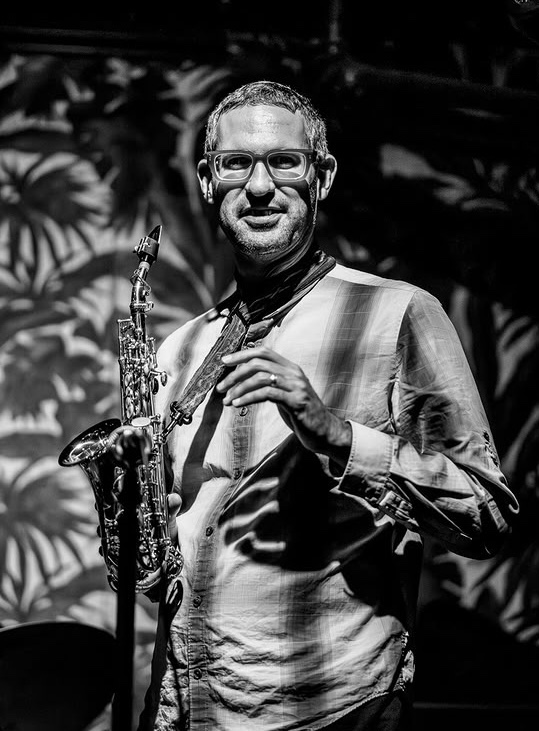
Photo by Peter Gannushkin
Social Media Stuff:
Facebook: Danny Kamins
Instagram: @dannykamins
TikTok: @dannykamins
Email: danny.kamins@gmail.com
I used to have a biography here listing people I’ve played with as well as press, but I have decided to replace that with 7 different points that describe my approach to playing the saxophone (mostly sopranino, soprano, and alto at this point) in both solo and group settings. This is a combination of primary and secondary material.
- The use of circular breathing in tandem with producing different voices/melodies in different pitch ranges between the fundamental tones and overtones that may overlap or remain separate. Horizontal/scalar fingerings, more vertical/arpeggiated fingerings, and alternate fingerings/multiphonics are used. There should be as few breaks as possible, and the tempo can vary from extremely slow to extremely fast; harsh transitions are acceptable as well as smooth ones. This is basically a method of biofeedback between the cardiovascular system and the creative center of the brain- to quote the great saxophonist Evan Parker, “sometimes the imagination leads the body and sometimes the body leads the imagination.”
- The use of multiphonics, combined with flutter tongue for accent at times to produce multiple tones/chords at the same time. This is a bit different than #1, as a good amount of space (possibly 5-30 seconds, maybe even more) should be used in between the tones/chords. The process of discovering these is through the use of alternate fingerings that will vary by player/saxophone/mouthpiece/reed setup. Resolution between chords, or keeping one voice(s) constant while the other(s) change, is highly encouraged if possible; this increases variety/potential.
- The use of percussive effects via slap tongue, breath timbres/percussion, and no mouthpiece buzzing. Again, the process of discovering these will vary by player/saxophone/mouthpiece/reed setup.
- The use of bebop phrasing/swing rhythm. This is in the tradition of jazz masters such as Charlie Parker, Warne Marsh, John Coltrane (among many others). But I don’t follow them! Rather than resorting to plagiarism or playing “licks” that have been codified by the US (and now international) jazz education systems, I use one’s own personal understanding of chromatic tonal systems to create one’s own personal chromatic resolutions. As these strategies are being discussed here for solo playing exclusively, keep in mind that the way a player will resolve a line will possibly (and should!) be different in a solo context as opposed to a group context. The term “bebop” refers more to rhythm than a specific tempo; the tempo can vary from extremely slow to fast, and circular breathing can be utilized to increase density.
- A variation of #4. The concept of pitches/chromatic tonal systems are still here, but the rhythm is changed or altered to be played in an infinite variety of methods, as rhythms can be subdivided infinitely; the swing rhythm has been broken. Contours/intervals vary from being scalar (smaller intervals/contours) to vertical (large intervals/contours).
- The use of ballad playing/long meter form to create melodies exclusively. This is in the tradition of the work of John Coltrane, Albert Ayler, Archie Shepp (among many others).
- The use of reed biting “teeth on the reed” to generate high pitches, as well as high and low pitches simultaneously. This technique has its similarities to #1; it can be circular breathed or not.
 Danny Kamins